Sewing Machine Needle Sizes Chart: 80/12, 90/14 and Which Fabric
The tool this guide uses
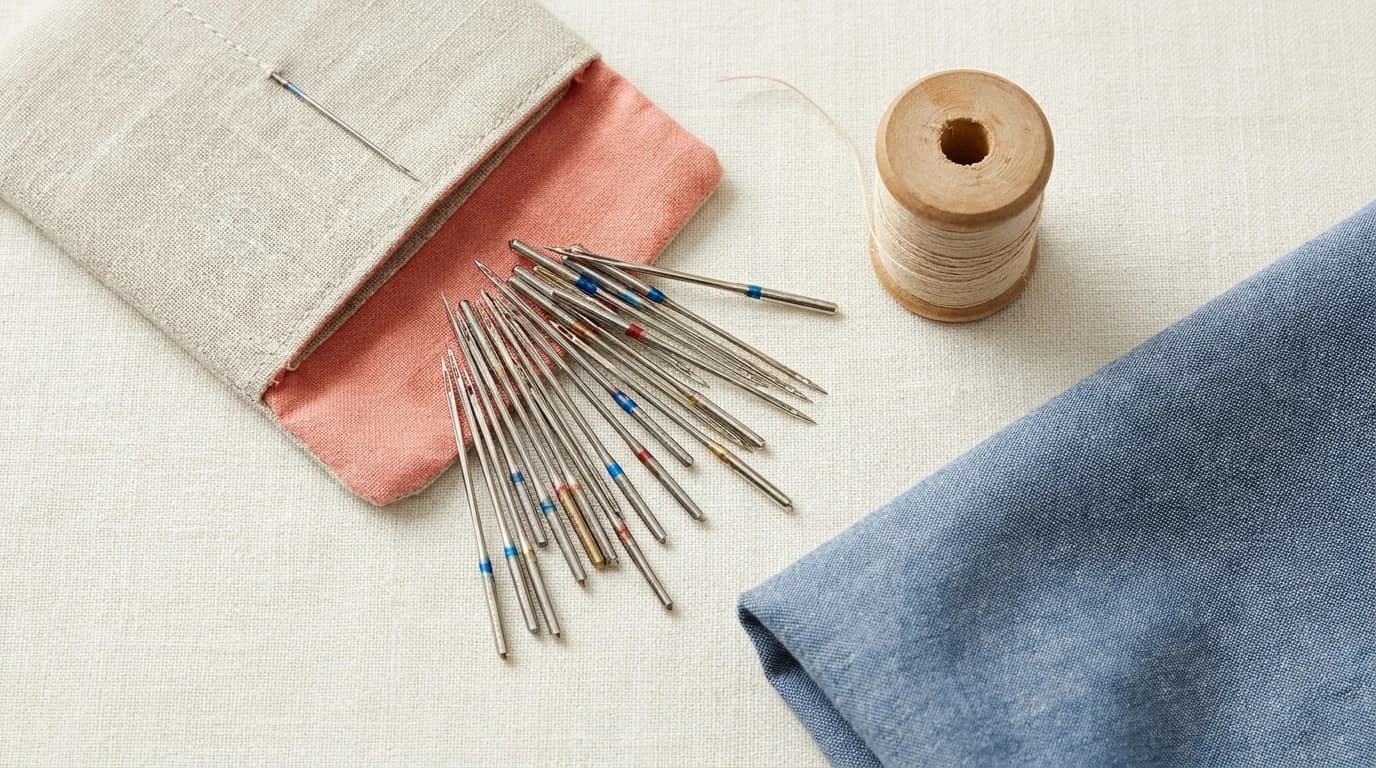
Machine Needles · Schmetz Universal Needles$13.91 4.9 out of 5 stars · 1,227 ratings
Assorted sizes, so you can match the needle to each fabric in the chart.
Selected through product research. We may earn a commission; it never changes a pick.
The short version
- Check needle system compatibility before choosing size.
- 80/12 is finer than 90/14; size alone does not determine fabric suitability.
- Type includes point, eye, scarf and blade design, not just sharp versus rounded.
- Leather cutting points are not for ordinary woven or knitted fabrics.
- A single colour band is not enough to identify every SCHMETZ needle type.
- Replace damaged needles and investigate repeated skipping or thread damage.
Your machine came with a packet of needles and one of them is now blunt. The rack in the
shop offers an 80/12, a 90/14, something with a purple stripe and something called a
Microtex. Nothing on the shelf says which is which.
It is simpler than the packaging makes it look. There are two numbers, and they are the same number twice. There are about ten types, and most people use two. And the colour system is genuinely clever once somebody tells you the one rule it runs on.
This is the reference page. It sits at Level 1 of The Pattern, Threader, next to threading the machine and winding a bobbin.
Two shortcuts, if you came for an answer rather than an explanation. To see which pack to buy, our machine needle picks compare the current packs side by side. To get a type and size for a fabric you already have, the needle guide looks it up in SCHMETZ's own fabric chart.
Two numbers, one measurement
Every needle carries a pair like 80/12. The first is the European metric size, the
second the American one. They are not two measurements — they are two names for one
needle.
SCHMETZ, the German maker whose needles fit most home machines, measures the blade diameter and multiplies by 100: a blade 0.80 mm across is a size 80. The American scale is separate, but the makers standardised the two years ago, so 80 always equals 12 and 90 always equals 14. There is no conversion to do.
| Size | Blade | Think of it as |
|---|---|---|
| 60/8 | 0.60 mm | Finest |
| 70/10 | 0.70 mm | Light |
| 75/11 | 0.75 mm | Knits |
| 80/12 | 0.80 mm | The default |
| 90/14 | 0.90 mm | Sturdy |
| 100/16 | 1.00 mm | Heavy |
| 110/18 | 1.10 mm | Heaviest |
Rule of thumb: the number is thickness and nothing else. A bigger number is a fatter needle punching a bigger hole. It says nothing about the shape of the point — that is what the type is for.
That also settles the two questions people ask most about the chart. A 9 is finer than a 14: the American 9 pairs with metric 65, a 0.65 mm blade, against 0.90 mm for a 14. And a 75/11 is a hair finer than an 80/12, 0.75 mm against 0.80 mm. SCHMETZ calls the 80 slightly larger than the 75, which is about the size of the difference.
Most people only ever buy two of these. A mixed pack of machine needles around 80/12 and 90/14 covers nearly everything on the chart below, and the needle guide will name a size and a type for a fabric you already have in your hand.
What we'd buy for this
One pick per category, chosen from the research pages linked in this piece. Borrow before you buy — nothing here is required to start.
 Machine Needles
SCHMETZ Universal 130/705$7.45 4.8 out of 5 stars · 709 ratings
Priced in the lower half of this category; universal points, the default for ordinary woven fabric.
 Thread
Coats & Clark thread$8.50 4.7 out of 5 stars · 4,705 ratings
The least expensive pick in this category, which makes it the low-risk way to find out whether you'll keep at it; all-purpose polyester, which covers nearly everything a beginner sews.
Researched from listings, specs and owner feedback — never hands-on testing. We may earn a commission; it never changes a pick.
The chart, arranged by what you are actually sewing
SCHMETZ publishes its guidance as an A-to-Z list of fabrics, precise and almost unusable at the cutting table. Regrouped by weight, which is how you meet fabric in real life:
| What you are sewing | Examples | Type | Size |
|---|---|---|---|
| Sheer and very fine | Chiffon, organza, voile | Universal or Microtex | 60/8–70/10 |
| Light woven | Poplin, lawn, shirting | Universal or Microtex | 70/10–80/12 |
| Medium woven | Quilting cotton, linen, flannel | Universal | 80/12–90/14 |
| Heavy woven | Denim, canvas, twill | Jeans | 90/14–110/18 |
| Light knit | Jersey, T-shirt cotton | Jersey (ball point) | 70/10–90/14 |
| Knit with elastane | Lycra, swimwear | Stretch | 75/11–90/14 |
| Coated textiles | Faux leather, vinyl, oilcloth | Often Microtex or a manufacturer-recommended nonstick needle; test the backing | Check the material and needle-maker guidance |
| Genuine leather | Garment leather | Leather cutting point, where recommended | Match leather thickness and machine capacity |
| A quilt sandwich | Top, batting, backing | Quilting | 75/11–90/14 |
Buying one thing? A mixed pack of Universal needles in the middle sizes. That is what a starter machine needle pack is for, and it covers the first pillowcase end of the range.
The eight types you will actually meet
Point shape is the part that matters. A ball point pushes the loops of a knit aside; a suitable point penetrates a woven; an ordinary woven needle is not a leather-style cutting point. Use the wrong one and you get skipped stitches or laddered holes with nothing wrong with your machine.
| Type | Point | Reach for it when |
|---|---|---|
| Universal | Slightly rounded | Everyday wovens and gentle knits |
| Jersey / Ball Point | Medium ball | Knits, so loops part instead of snapping |
| Stretch | Medium ball point with special eye/scarf | Elastane knits that still skip stitches |
| Jeans / Denim | Modified ball point and reinforced blade | Denim, canvas, thick deflecting seams |
| Microtex | Very sharp | Silk, microfibre, crisp topstitching |
| Leather | Cutting point | Suitable genuine leather; do not use on ordinary wovens or knits |
| Quilting | Tapered | Piecing and quilting through layers |
| Embroidery | Enlarged polished eye | Rayon and polyester embroidery thread |
Two more are worth knowing by name:
- Topstitch — an enlarged groove for thick decorative thread.
- Metallic — a polished eye for the threads that shred.
The colour bands decode themselves — once you know the rule
Use SCHMETZ's current colour-code chart with the packet. On most colour-coded household needles, the upper band identifies type and the lower identifies size. A Microtex 80/12 has purple above orange.
A single band does not prove the needle is Universal. SCHMETZ also lists Hemstitch, Double Eye and Quick Threading among types with size-only bands; older needles can have different markings. Other brands have their own identification systems. If you cannot identify a loose needle reliably, use a labelled needle rather than guessing from colour.
What the rest of the packet means
- 130/705 H — the needle system, not the size.
130/705means a flat shank, and SCHMETZ says it fits 99% of home sewing machines. TheHis from a German word meaning scarf: the scooped indentation behind the eye. - Not every machine takes it. The same SCHMETZ FAQ notes that machines built for
the
705 Bsystem often cannot clear the longer point of a130/705 Hneedle, and industrial machines use their own systems. If your manual names a different system, buy that one. - A trailing letter — the type in shorthand.
Jis jeans,Qquilting,Mmicrotex. - ELx705 — not for your sewing machine. That is the serger system, grooved on both faces, and not interchangeable. If that is what you are shopping for, read serger versus sewing machine first.
Nobody at SCHMETZ will tell you to change it every eight hours
Search this and you will be told to change the needle every six to eight hours, or after every project. It is repeated so uniformly it reads like a specification.
It is not one. SCHMETZ was asked directly, and their published answer to how often should I change the needle opens: Hard to know. It could be three seconds or 20 hours. They then decline the question and replace it with a better one — what the clues are:
- Shredded or broken thread
- Skipped or uneven stitches
- Puckering, or damage to the fabric
- Stitch holes larger than the cloth should show
- A popping, clicking or clunking sound as the needle enters
Why the hour count fails: a needle that meets a pin is finished instantly, and one running through quilting cotton can go all weekend. Time is a proxy for wear, and a bad one.
Changing after every project is still a good habit — a fresh needle costs less than a fat quarter. Just know it is a convention adopted to avoid diagnosing, not a measurement.
Note too that three of those clues — shredded thread, skipped stitches, puckering — are equally the symptoms of a threading or tension fault. The needle is the cheap thing to rule out: swap it, sew a test seam, and only then read sewing machine tension problems.
The 45-degree thread test
One more thing hides in that FAQ, and it settles the other half of the question: whether the needle suits your thread rather than your fabric.
- Hold a length of thread at roughly 45 degrees.
- Thread the needle onto it and let go.
- Matched, the needle slides slowly down the thread under its own weight.
- Stuck, the thread is too thick for the eye — go up a size.
It works because, per the same SCHMETZ FAQ, the eye of a standard Universal needle is about 40% of the needle size — a size 100 has an eye roughly 0.4 mm wide. Embroidery needles and other large-eye types are the exception. Thread forced through it is abraded every stitch, which is why it shreds before it snaps.
Keep a mixed pack in the box, change it when the machine tells you to, and bin the old one somewhere sharp-safe. Wonky seams are the whole point — blunt needles are not.
Right needle in the machine? Here is what it wants next to it.
Frequently asked
What does 80/12 mean?
One size in two numbering systems: metric 80 corresponds to a blade about 0.80 mm in diameter and the traditional size 12.
Is a single orange band always Universal 80/12?
No. Orange identifies size 80/12 in the SCHMETZ system, but several types have only a size band. Use the packet and current manufacturer chart to identify the type.
Can I use a leather needle on faux leather?
Do not assume so. Faux leather may have a woven or knitted backing that a cutting point damages. Follow the material and needle-maker guidance and test; Microtex or a suitable nonstick needle may be recommended.
Prices and StitchScores reflect our most recent research and refresh on a cycle — confirm the live price before buying. We may earn a commission from affiliate retailers; it never changes what we recommend. See how we score gear.
Read next
No-Sew Fleece Tie Blanket: Sizes, Yardage and Knots
How much fleece to buy for a toddler, child, throw or adult-length tie blanket, the corner-square math behind it, and four ways to finish the fringe.
Should You Prewash Fabric? How Much Cotton Shrinks
Fabric makers' own shrinkage figures by fiber, when to prewash and when to skip it, how to handle precuts and dye bleed, and a swatch test for your fabric.