How to Hem or Shorten Jeans and Keep the Original Hem
Tools this guide uses
Machine Needles · SCHMETZ Jeans 100/16$20.95 4.8 out of 5 stars · 705 ratings
A jeans needle in 100/16, not the universal one already in the machine.
Thread · SINGER 67120 jean thread$6.15 4.6 out of 5 stars · 2,125 ratings
Gold jeans thread for a hem that is meant to be seen.
Seam Rippers · ZMAAGG Seam Rippers, 2 Big and 2 Small$5.39 4.8 out of 5 stars · 250 ratings
On the guide's keep-the-original-hem tool list.
Researched, not hands-on tested. We may earn a commission; it never changes a pick.
The short version
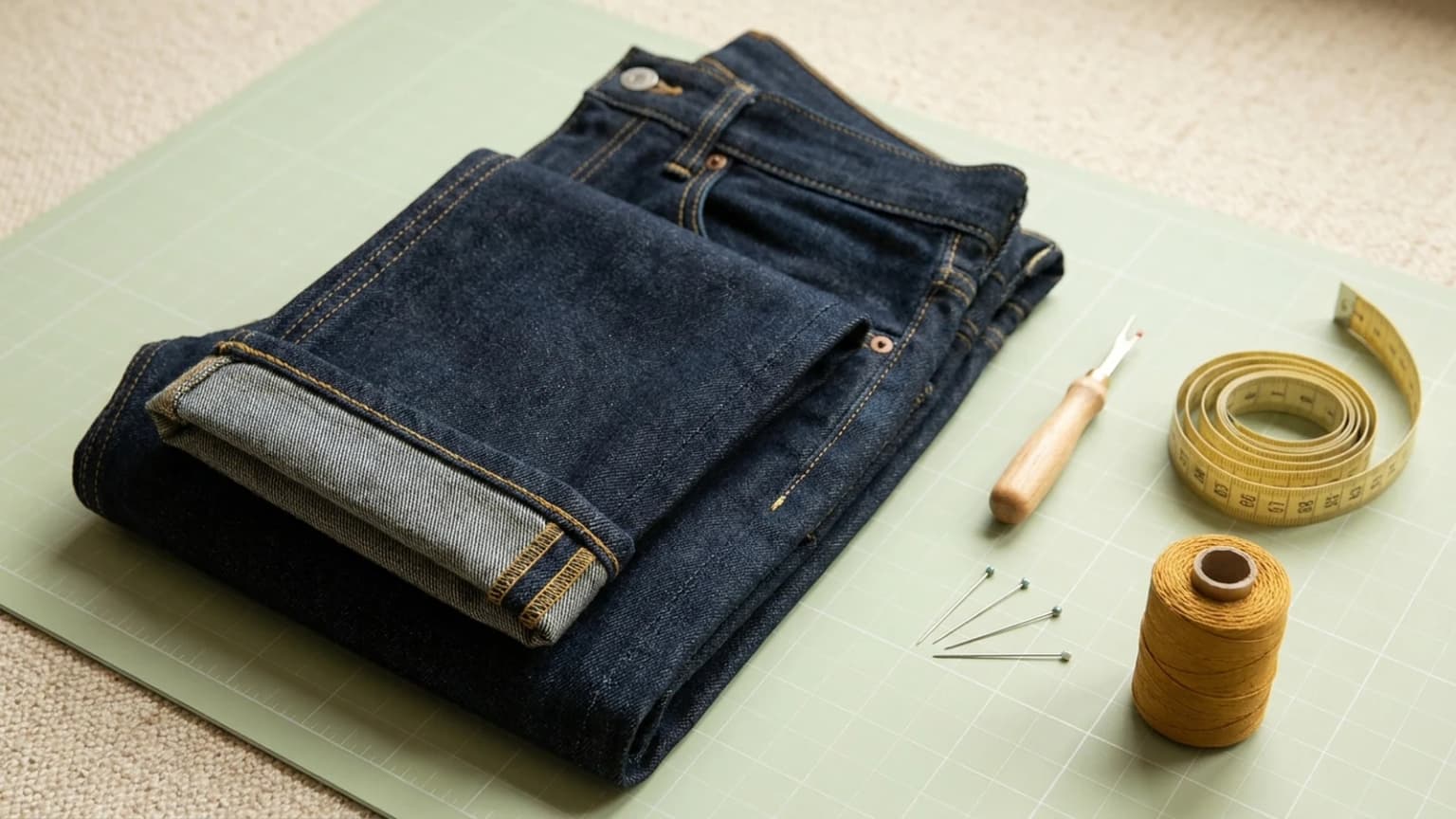
- The factory look is a fade line and thick gold topstitching created by an industrial wash, so keeping the original hem is the only way to keep it — nothing done at home reproduces it.
- Mark the new length, then a second line twice the original hem band's depth above it, and fold until the old hem's bottom edge meets that line.
- No machine needed for the original-hem method: a small backstitch by hand along the same line holds the tuck and hides just as well.
- Fit a jeans needle — SCHMETZ builds it on a reinforced blade — in 90/14 for mid-weight denim and 100/16 where a folded hem crosses a side seam. Singer asks for at least a size 16.
- Thread splits by job: all-purpose in a matching blue for the invisible tuck, thicker jeans or topstitching thread only where the stitching is meant to be seen, with all-purpose in the bobbin either way.
- The original-hem trick assumes a straight leg. On a tapered or flared leg the folded circle no longer matches the leg it lands on, and cutting and rebuilding is the honest answer.
- Barrel legs narrow towards the hem, so shortening widens the opening. Take the inseam back in over the lower leg to keep the shape, then rebuild the hem.
Jeans do not hem like other trousers. A factory hem was sewn on an industrial chainstitch machine in thread far thicker than anything in your box, and then the garment was washed, sanded or stone-treated — which is why the folded edge came out paler than the leg above it. That fade line and the gold stitching are what a stranger's eye reads as these jeans came this way. Cut them off and you get a hem that is technically correct and unmistakably an alteration.
So the denim question is not really how do I hem — that general answer, machine hem and hand blind hem and hem tape, lives in how to hem pants. It is which of two jobs you are doing: keeping the original hem and hiding a tuck above it, or cutting the leg and rebuilding a hem that at least reads as denim. Both are straight lines on a flat edge. This is Level 1 of The Pattern, Threader — the difficulty is not the sewing, it is the setup.
If keeping the factory hem is what you came for, skip straight to that method. It works on a machine or by hand, and it is the one to try first on straight-leg jeans.
What you need: a jeans needle — a size 16, in a machine that will take one — matching thread, a seam ripper, pins, chalk or a removable marker, a tape measure, an iron, and something to level the presser foot over the side seams.
Set the machine up first — this is where denim hems actually fail
Almost every "my machine can't handle denim" story is a needle story, and the rest is a presser-foot story. If you hem a lot of denim — or you are also sewing canvas, webbing and bag hardware — a heavy-duty machine makes it less of a fight. It is a second machine, though, not the thing standing between you and one pair of jeans.
The needle
Use a jeans/denim needle, not the universal one already in the machine. SCHMETZ builds it with a medium ball point on a reinforced blade, so it punches thick wovens with less deflection — and deflection is what causes both the skipped stitches and the snapped needle that scare people off denim for a year.
Take 90/14 for mid-weight or stretch denim, 100/16 for rigid denim or anywhere you go through a folded hem and a side seam at once, and 110/18 for heavy raw denim. SINGER's own hemming-jeans guide is blunter: a denim needle in at least a size 16, possibly an 18. Put a fresh one in, and keep a pack of machine needles with a couple of denim sizes in it. The jeans needle we link is SCHMETZ Jean & Denim in 100/16, five cards of five, sold on Amazon by SCHMETZ.
For visible gold topstitching the other candidate is a Topstitch needle, which SCHMETZ gives a slightly rounded point and an elongated eye for heavier thread.
The thread
Two separate decisions, and people conflate them.
Thread that must disappear — the tuck in Method 1 — is ordinary all-purpose polyester in a blue matching the leg. Singer specifies all-purpose in needle and bobbin for that method, precisely because nothing is being topstitched.
Thread that must be seen — the visible hem in Method 2 — is topstitching or jeans thread. Gütermann's Denim thread is a No. 50 polyester and its own spec asks for a jeans needle in NM 90 to 110. Keep all-purpose in the bobbin even then; heavy thread top and bottom is how tension goes sideways.
Match the gold, not the denim. Hold candidate spools of thread against the existing topstitching on the back pockets, in daylight. Factory jeans thread runs warm ochre-gold, sometimes copper or dull mustard; a lemony gold reads wrong from across a room.
The gold jeans thread we link is SINGER's Blue Jean Thread in Old Gold: 100 yards of heavy-duty polyester that SINGER describes as colorfast and washable. Check the shade against your pockets as above before you sew with it.
The foot and the settings
- Free arm. Take the accessory tray off so the leg becomes a tube around the machine arm. Both Singer methods start here.
- Stitch length long-ish, 3 to 3.5 mm. Short stitches perforate denim and look fussy beside factory topstitching, which is long.
- Reduce presser-foot pressure if your machine has the dial. Thick fabric wants less.
- A walking foot is optional, but it removes the layer creep that leaves the second leg short — see walking feet. An edge-stitch or bi-level foot from the presser feet box holds an even topstitching line.
What we'd buy for this
One pick per category, chosen from the research pages linked in this piece. Borrow before you buy — nothing here is required to start.
 Machine Needles
SCHMETZ Jeans 100/16$20.95 4.8 out of 5 stars · 705 ratings
Hemming jeans and sewing denim or canvas. SCHMETZ gives its jeans needle a medium ball point on a reinforced blade, and 100/16 is the size for rigid denim and the thick layers at a jeans hem.
 Sewing Machines
Brother XM2701$149 4.6 out of 5 stars · 19,162 ratings
A first machine — 27 built-in stitches is enough to sew clothes without a menu to decode, and the listing specifies the automatic needle threader and the jam-resistant drop-in top bobbin, which are the two steps beginners most often give up on.
 Seam Rippers
ZMAAGG$5.39 4.8 out of 5 stars · 250 ratings
Keeping a ripper at every work spot — two large and two small rippers in one set; the listing gives 5.5 and 3.4 inches, with a red safety ball and a small pair of yarn scissors.
Researched from listings, specs and owner feedback — never hands-on testing. We may earn a commission; it never changes a pick.
Measure once, with the shoes on
Put on the shoes you will actually wear with these jeans, stand normally, and fold the excess up on the outside of one leg until the hem sits where you want it — on most jeans, just kissing the top of the shoe. Pin, walk a few steps, sit down, look again. Then take them off and measure the fold. That number is the amount removed, and it is the only one you need. Transfer it to the second leg by measurement, never by re-pinning on your body: you will get a different answer and two different legs.
Pin it long. You can take another half inch off tomorrow. You cannot put it back.
Method 1: shorten jeans and keep the original hem
Sometimes called the euro hem. You are not hemming at all — you fold a tuck into the leg and stitch it, leaving the factory hem hanging underneath as the bottom of the jeans.
- Work on the outside of the leg, jeans right side out. Get this wrong and the tuck ends up inside, where it will not press flat.
- Mark the new length, then a second line above it at twice the depth of the original hem band. Measure the band from its bottom edge to the topstitching (usually about half an inch), double it, and mark that distance above your finished-length line. Fold the leg up until the bottom edge of the original hem lines up with the second line. That is Singer's geometry, and it lands the factory hem exactly on your new length.
- Pin every couple of inches, checking the original stitching line stays parallel all the way round and the leg has not twisted on itself.
- Sew a straight line immediately above the original hem's topstitching, through both layers, in matching all-purpose thread. Close is the whole trick — a millimetre or two above the factory stitch and your line hides in it.
- Trim the excess inside to about half an inch and zigzag or overedge the raw edge so it does not fray in the wash. Any of the seam finishes that need no serger will do.
- Press the tuck upward, towards the knee, and the original hem back down flat.
The factory hem is the bottom of the jeans again — fade line intact, gold stitching intact, a small ridge hidden inside the leg. Alterations shops charge more for this than for a plain hem, which tells you how the two compare.
By hand, with no machine
The same tuck works with a needle and thread. It is slower, and perfectly sound for one pair.
- Fold, measure and pin exactly as in steps 1 to 3 above.
- Thread a sturdy hand-sewing needle with doubled all-purpose thread in the matching blue, and knot the end.
- Backstitch along the line immediately above the factory topstitching, through both layers, all the way round. Backstitch rather than running stitch: it lays a continuous line like a machine seam and holds when the tuck is pressed. If it is new to you, basic hand-sewing stitches shows it.
- Keep the stitches small, around an eighth of an inch, snug but not so tight that the denim puckers.
- At the side seams, stab rather than scoop. Push the needle straight down through the lump and pull it through underneath, then straight back up — one stitch at a time. A thimble helps, and pliers will pull a needle through where fingers cannot.
- Trim, finish the raw edge and press exactly as for the machine version.
Expect an evening for a pair. Done neatly, the hand-sewn line hides in the same place the machine line would.
The bump at the side seam
Where the flat-felled outseam crosses your stitching line there are suddenly six or eight layers, the foot tips nose-up, the feed dogs lose grip, and the machine skips stitches or jams. It is a geometry problem, not a power problem.
- Level the foot. A hump jumper (also sold as a Jean-a-ma-jig) is a small stepped shim you slide under the back of the foot approaching the seam, then under the front coming off it. A folded scrap of the same denim, or a folded index card, does the same for nothing.
- Use the button, if your foot has one. On Brother machines the zigzag foot has a locking pin — the black button on its left side — and Brother's own thick-fabric guidance is to press it so the presser foot stays level while sewing. The same page offers the paper-under-the-heel trick as the alternative.
- Hand-wheel across it. Stop short of the bump and turn the handwheel towards you, stitch by stitch, before resuming the pedal.
- Flatten it first. A firm press with a steam iron compresses the layers; the r/sewing regulars go further and hammer the seam with a mallet through a scrap of cloth — the same reason factory hems are pounded flat.
- Know the ceiling. That Brother page warns that above roughly 6 mm of fabric, or if you push it through, the needle may bend or break. A folded denim hem crossing a flat-felled seam sits right at that edge, which is why level and slow beat a bigger motor.
Tapered and barrel-leg jeans: when the original hem fights you
The tuck assumes the leg is about as wide where the hem is going as where it came from. On a straight leg it is. On a tapered or flared leg it is not: you are folding a wider circle against a narrower one, or the reverse, and you get puckering, a ripple, or a small bell. The consensus in r/sewing is consistent — keep the original hem on straight legs and expect the trick to fight you otherwise. Limits worth knowing:
- A small amount off a mild taper: the fabric eases in and presses flat if you distribute the fullness rather than letting it pool at the seams. Baste it and try it on before you sew for real.
- A lot off, or a genuinely skinny taper: cut and rebuild.
- Any flare — the folded hem is wider than the leg it lands on, with nowhere for the excess to go.
Barrel legs
Barrel jeans are the awkward new case. The leg curves out through the knee and back in to a narrower opening, so the hem sits at the narrowest point of a curve. Take length off the bottom and you cut the narrowest part away: the new hem lands where the leg is wider, the opening grows, and the curve looks chopped off. Neither hem method fixes that on its own. The advice that keeps coming up in r/SewingForBeginners threads is to decide what you want first:
- Keep the shape. Measure the width of the original opening before you cut. Shorten, then take the inseam back in over the lower few inches, drawing a smooth line from the old opening width at the new hem up to where the seam starts to curve. Try them on, sew, trim, and rebuild the hem with Method 2. Take in the plain seam, not a flat-felled one, which is far thicker to re-sew.
- Straighten the leg. Some people take this as the moment to lose the curve altogether, re-sewing the side seams straight and then hemming plainly.
- Take off only a little. Treat it like a mild taper: the width changes little, and the original-hem tuck can ease in.
Method 2: cut and rebuild the hem
When the original hem is beyond saving — frayed through, or the leg is tapered — build a new double-fold hem. It will not have the fade line, and nothing done at home will: that pattern is the residue of an industrial wash on a finished garment. Matching gold topstitching gets you most of the way.
- Mark the finished length, then mark a cut line one inch below it, parallel to the existing hem, all the way round — Singer's guide leaves exactly that allowance.
- Cut on the line, checking both legs match before you cut the second.
- Fold up half an inch and press. Fold up half an inch again, enclosing the raw edge, and press again. A double half-inch fold is the right depth for denim, which gets thick fast.
- Topstitch from the inside leg seam so start and finish meet somewhere inconspicuous, holding an even distance from the folded edge.
- Backstitch, trim the tails, press.
To practise the fold-and-press rhythm at lower stakes first, fix a fallen hem is the same movement on one short section.
Denim is made by the iron
A hem is made by the iron and merely secured by the thread, and that is truer of denim than of anything else — cotton denim takes heat and steam happily and holds the crease.
- Press the original fold flat and open before you measure, or the old crease shadows through the new hem. Press each fold as you make it, not all at the end.
- Steam generously, and press means lift and set down. Sliding the iron along stretches the folded edge into a wave.
- A heavy iron does this for you; a light one makes you push, which is the wrong motion. See irons for what matters in one.
What it will honestly look like
Method 1, done carefully, is very hard to spot — the factory hem is genuinely still there, and the only tell is a slight thickness if somebody handles the cuff. Method 2 reads as a good hem in matching thread, and improves over three or four washes as the new fold wears.
Either way the first leg comes out wonkier than the second, and you will notice a wandering seam nobody else ever will. Wear them. Wonky seams are the whole point.
Hem done? Here is the kit that makes the next pair quicker.
Frequently asked
How do you hem jeans and keep the original hem?
Work on the outside of the leg with the jeans right side out. Mark the new length, measure the depth of the original hem band, and mark a second line twice that depth above the first. Fold the leg up until the bottom edge of the original hem meets the second line, pin all the way round with the factory stitching line staying parallel, then sew a straight line immediately above the original topstitching through both layers using matching all-purpose thread. Trim the excess inside to about half an inch, zigzag or overedge that raw edge, and press the tuck upward. The factory hem becomes the bottom of the jeans again with a small tuck hidden above it.
Can you shorten jeans and keep the original hem by hand?
Yes. Fold and pin the tuck exactly as for the machine method, then sew a small backstitch with doubled all-purpose thread along the line immediately above the factory topstitching, through both layers, all the way round. At the side seams, push the needle straight down and straight up through the lump one stitch at a time. Trim the excess inside, finish the raw edge and press the tuck up. Expect an evening for a pair.
What size needle do you need to hem jeans?
A jeans or denim needle rather than a universal one. SCHMETZ builds the jeans needle with a medium ball point on a reinforced blade so it deflects less in thick wovens. Use 90/14 for mid-weight or stretch denim, 100/16 for rigid denim or wherever a folded hem crosses a flat-felled side seam, and 110/18 for heavy raw denim. Singer's own hemming guide asks for a denim needle in at least a size 16, and possibly an 18 depending on the denim.
Do you need special thread to hem jeans?
Only when the stitching is meant to show. The tuck in the original-hem method is supposed to disappear, so ordinary all-purpose polyester in a blue matching the leg is correct, and Singer specifies all-purpose in both needle and bobbin for that version. For a visible rebuilt hem, jeans or topstitching thread gives the thicker line that reads as denim. Gütermann's Denim thread is a No. 50 polyester and its own spec asks for a jeans needle in NM 90 to 110. Keep all-purpose in the bobbin even then.
How do you sew over the thick side seam on jeans?
Level the presser foot rather than forcing the fabric. A hump jumper, also sold as a Jean-a-ma-jig, is a stepped shim you slide under the back of the foot approaching the seam and under the front coming off it, and a folded scrap of the same denim does the same job. Brother's guidance for thick fabrics is to use the presser foot locking pin on the zigzag foot so the foot stays level, or to place paper under the heel of the foot. Press the bump flat first, and hand-wheel across the thickest part.
Can you keep the original hem on tapered or skinny jeans?
Usually not well. The method folds the leg back on itself, which only lies flat when the leg is roughly the same width at both positions. On a taper you are folding a wider circle against a narrower one and the tuck puckers; on a flare the folded hem is wider than the leg it lands on. A small amount off a mild taper will ease in, but for a lot off, or on a genuine skinny leg, cut the leg and rebuild the hem instead.
How do you hem barrel-leg jeans?
Decide first whether you want to keep the curve. A barrel leg narrows towards the hem, so cutting length off moves the hem to a wider part of the leg and the opening grows. To keep the shape, measure the original opening, shorten, then take the inseam back in over the lower leg until the new opening matches, and rebuild the hem with a double fold. For a small amount, treat it like a mild taper and the original-hem tuck can ease in.
Prices and StitchScores reflect our most recent research and refresh on a cycle — confirm the live price before buying. We may earn a commission from affiliate retailers; it never changes what we recommend. See how we score gear.
Read next
Sewing Machine Needle Sizes Chart: 80/12, 90/14 and Which Fabric
Sewing machine needle sizes explained: what 80/12 and 90/14 mean, a size chart by fabric, why a 9 is finer than a 14, and how to read the colour bands.
How to Use a Sewing Machine Step by Step: A Beginner's Guide
How to operate a sewing machine step by step: the parts, threading, the bobbin, a first seam, backstitching, pivoting at corners and finishing off.