Quilt Size Chart: Standard Sizes, Batting and Backing
The short version
- No standards body sets quilt sizes, which is why every chart online publishes different numbers — the mattress and the batting packet are the only fixed points.
- The whole calculation is two lines: width is the mattress width plus twice the drop, and length is the mattress length plus the drop plus about 10 inches if you tuck under pillows.
- The drop is your decision, not a standard: 12 inches covers the sides of the mattress and 16 inches reaches past most bed frames.
- Buy your batting one package size up — a twin quilt with four inches of overage needs 76 by 98 inches and the twin packet is only 72 by 90.
- Wide 108-inch backing cuts a queen from about 8 yards of regular quilting cotton to 3 yards, with no seam to piece.
- Binding is perimeter plus about 12 inches, and each diagonal join between 2.5-inch strips costs 2.5 inches of length, so a twin needs 10 strips, not the 9 a flat divide-by-40 suggests.
Nobody governs quilt sizes. There is no standards body, no published specification, and no two charts online agree — which is why looking up a queen quilt turns up half a dozen different numbers. What is standardised is the bed underneath and the batting on the shelf. Once you know those two things you can work out every quilt size yourself, and adjust any row here for your own mattress rather than trusting a number a stranger typed.
This is that chart, with the arithmetic underneath it. It sits at Level 2 of The Pattern, Stitcher. If you have not made a quilt yet, read the beginner quilting guide first — this page assumes you already know what a quilt sandwich is.
The quilt size chart
| Quilt | Mattress it covers (inches) | Drop assumed | Finished quilt (inches) | Cut batting and backing (inches) | Backing at 42 to 44 inches wide |
|---|---|---|---|---|---|
| Baby / crib | Crib, 27.25 x 51.6 minimum | Lies on top, no drop | 36 x 52 to 45 x 60 | 48 x 60 | 2¾ yd |
| Lap / throw | None — a sofa, not a bed | Not applicable | 48 x 60 to 70 x 80 | 68 x 80 | 4½ yd |
| Twin | 38 x 75 | 12 to 16 in | 62 x 87 to 70 x 101 | 76 x 98 | 5½ yd |
| Twin XL | 38 x 80 | 12 to 16 in | 62 x 92 to 70 x 106 | 76 x 104 | 6 yd |
| Full / double | 53 x 75 | 12 to 16 in | 77 x 87 to 85 x 101 | 90 x 100 | 7½ yd |
| Queen | 60 x 80 | 12 to 16 in | 84 x 92 to 92 x 106 | 98 x 108 | 8¼ yd |
| King | 76 x 80 | 12 to 16 in | 100 x 92 to 108 x 106 | 112 x 108 | 9 yd |
| California king | 72 x 84 | 12 to 16 in | 96 x 96 to 104 x 110 | 108 x 112 | 9 yd |
The last two columns are worked from one typical finished size inside each range (crib 40 x 52, lap 60 x 72, twin 68 x 90, twin XL 68 x 96, full 82 x 92, queen 90 x 100, king 104 x 100, California king 100 x 104), with four inches of overage on every side. Yardage assumes 40 inches of usable width once the selvedges are trimmed off a 42-to-44-inch bolt, a half-inch seam on each side of every backing join, and rounds up to the next quarter yard. For any other size, the quilt backing and binding calculator runs the same arithmetic on your own numbers.
And the two columns that decide what you put in the basket:
| Quilt | Smallest batting package that covers the cut size | Backing at 108 inches wide (about 106 usable), print upright |
|---|---|---|
| Baby / crib | Crib at home, twin if a longarm wants four inches | 1¾ yd |
| Lap / throw | Twin | 2¼ yd |
| Twin | Queen | 2¾ yd |
| Twin XL | Queen | 3 yd |
| Full / double | Queen | 3 yd |
| Queen | King | 3 yd |
| King | King | Will not fit in one piece: the 112 x 108 cut is wider than about 106 usable inches either way, so piece it |
| California king | King | Same problem at 108 x 112: piece it |
That second column is the part most charts leave out, and it surprises people every time. Read on for why.
The gear this chart assumes: a long quilting ruler, enough batting to cover the cut size, and — at the bottom of the table — a machine with the throat space to roll a sandwich that big through, which is what quilting machines buy you.
What we'd buy for this
One pick per category, chosen from the research pages linked in this piece. Borrow before you buy — nothing here is required to start.
 Quilting Rulers
LINXIAO$9.99 4.8 out of 5 stars · 1,141 ratings
Squaring up quilt blocks — four acrylic squares from 3.5 to 10.5 inches; the listing states eighth-inch markings and 45-degree guides.
 Quilt Batting
FIVEIZERO 100%$12.99 4.7 out of 5 stars · 502 ratings
Priced in the lower half of this category; cotton batting, which quilts flat and softens with washing; low loft, which is the easier one to feed through a domestic machine.
 Quilting Machines
Brother HC1850$249.99 4.6 out of 5 stars · 5,145 ratings
Lettering and decorative work — 185 stitches including 55 alphanumeric ones, plus the wide table and eight feet the listing includes.
Researched from listings, specs and owner feedback — never hands-on testing. We may earn a commission; it never changes a pick.
Where the mattress numbers come from
The bed is the only fixed thing in this whole calculation. The Better Sleep Council, the consumer arm of the mattress industry's trade association, publishes the standard sizes: twin 38 by 75, twin XL 38 by 80, full 53 by 75, queen 60 by 80, king 76 by 80 and California king 72 by 84.
Full is worth a footnote: you will see it published as both 53 and 54 inches wide depending on the source. It makes no difference at quilt scale, but it is a fair warning about how much work the word standard is doing here.
Crib is the exception: it is the one bed size written into federal law. Under 16 CFR 1241.2, a full-size crib mattress must measure at least 27¼ inches wide and 51⅝ inches long — a minimum, not a fixed size. Worth saying plainly, too: current infant safe sleep guidance is against loose bedding in a crib, so a baby quilt is usually a floor mat, a pram cover or a keepsake rather than something that goes in the cot.
Drop is the number you actually choose
Everything else follows from one decision: how far down the sides you want the quilt to hang. That is the drop, and it is the reason no two charts match — every chart author picked a different one and then published the result as a standard.
The arithmetic is two lines:
- Width = mattress width + (2 × drop)
- Length = mattress length + drop at the foot + 10 inches if you tuck under the pillows
A 12-inch drop covers the sides of the mattress and stops. Sixteen reaches past the base of most bed frames. Anything longer is a bedspread — a lot more quilting for a part nobody sees. The chart runs 12 to 16, which is why every row is a range.
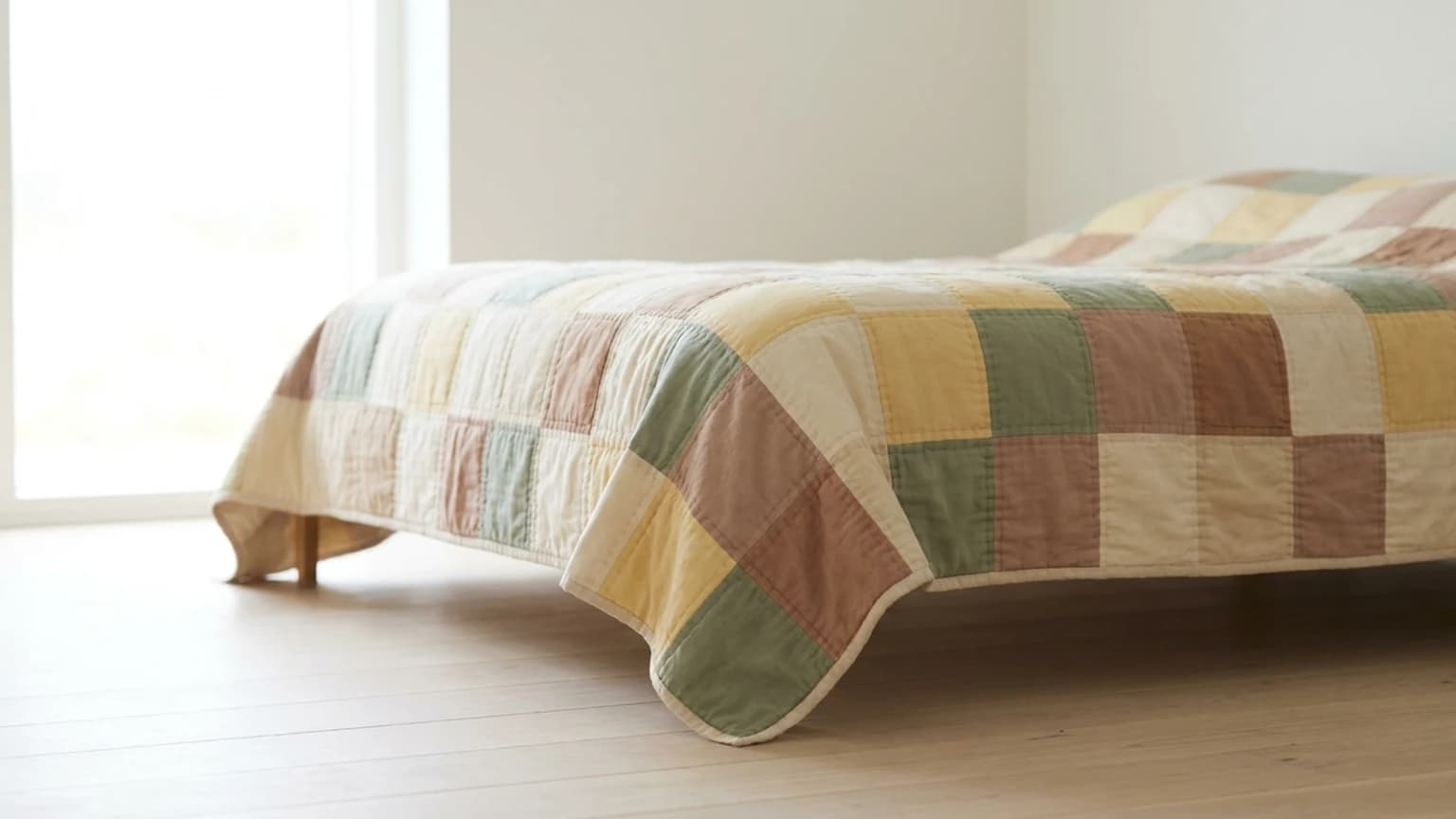
Before you commit, measure the depth of your own mattress. A slim eight-inch mattress and a pillow-top nearly twice that are the same bed size on paper and want quilts several inches apart. Two minutes with a tape beats any chart, including this one.
Lap and throw: the size nobody agrees on
A lap quilt has no mattress to measure against, so there is nothing to derive it from — which is exactly why the published sizes vary so wildly.
Ask r/quilting and you get an honest spread rather than a number. In threads on best lap quilt size, quilters describe everything from around 40 by 45 inches for a blanket over the feet, up to roughly 70 by 80 for something you can properly cocoon in, with the 60-by-72 area coming up repeatedly as the compromise. The recurring advice is to size it to the person and to how they will use it — over the knees in a chair, or napping full length on a sofa.
A practical middle: 60 by 72 inches. It fits a twin batting package, it covers an adult on a sofa, and it is still small enough to wrestle through a domestic machine. That is the size our quilted lap throw project uses, at 36 by 48, scaled up — start there if you want the whole thing walked through step by step.
Buy your batting one size up
Here is the finding that makes this page worth bookmarking: the batting package named after your bed is usually too small for the quilt that fits that bed.
Compare the cut column in the chart with what is actually in the packet:
| Package | The Warm Company, Warm and Natural | Pellon Nature's Touch 80/20 | Quilters Dream 80/20 |
|---|---|---|---|
| Craft | 34 x 45 | 34 x 45 | 46 x 36 |
| Crib | 45 x 60 | 45 x 60 | 46 x 60 |
| Throw | Not sold | Not sold | 60 x 60 |
| Twin | 72 x 90 | 72 x 90 | 93 x 72 |
| Full / double | 90 x 96 | 81 x 96 | 96 x 93 |
| Queen | 90 x 108 | 90 x 108 | 108 x 93 |
| King | 120 x 124 | 120 x 120 | 122 x 120 |
Those figures come from the makers themselves — Quilters Dream, Pellon and The Warm Company's own listing for the full size. Notice that they do not agree either: three brands publish three different Full sizes, nine inches apart at the extremes, and only one of them sells a Throw at all.
Now do the subtraction. Even the smallest twin in the chart, 62 by 87 at a 12-inch drop, needs 70 by 95 once you add four inches of overage on each side, and the chart's cut size for a twin is 76 by 98 — while the twin package is 72 by 90. It does not fit. The same holds at almost every size, which is why the second table above reads one row down from what you would expect.
Two things save you. Cutting your own from a bolt sidesteps package sizes entirely, and quilting it yourself needs far less overage than a longarm does — on r/quilting, the answers on this cluster around four to six inches of backing for a longarm and two to three inches when you are quilting on your own machine, with the consistent advice to ask your longarm quilter what they want rather than guessing.
While you are reading the packet, read two more numbers on it. Every maker states a maximum quilting distance — how far apart your lines of stitching may be before the batting starts to shift and clump. The Warm Company says quilt or tie up to 10 inches apart for Warm and Natural; Quilters Dream states 8 inches; Pellon states 8 to 10. That number decides how much stitching you have signed up for. The Warm Company also publishes its shrinkage — around 3 percent in a cold first wash, about 5 percent in warm water for a more antique, puckered look — which is a design decision, not a defect. Compare packets in quilt batting before you buy.
Backing: two widths, two answers
Quilting cotton comes off the bolt around 42 to 44 inches wide, so any quilt wider than about 40 inches of usable fabric needs the backing pieced from two or three lengths joined with a seam. That is where the yardage in the chart comes from: count how many widths you need, multiply by the length, divide by 36, round up.
The alternative is wide backing, sold at 108 inches — Robert Kaufman's Kona Wide is 100 percent cotton at that width, and most quilt shops carry printed equivalents. One piece, no seam, and the yardage drops dramatically: a queen backing falls from 8¼ yards of regular cotton to 3 yards of wide. It costs more per yard and usually less per quilt, which is the arithmetic quilters on r/quilting reach for constantly.
Binding strips for every size
Binding is the last fabric you buy and the one most often bought short, because the usual rule of thumb (add up the sides, divide by the width of the fabric) forgets that joining the strips eats length.
The arithmetic, with every assumption on the table:
- Length needed = the perimeter of the finished quilt + about 12 inches for turning the corners and joining the two ends. That 12 is our allowance, not a standard; some quilters use 10, and more is harmless.
- Each strip is cut across the width of the fabric, and we count 40 usable inches once the selvedges come off, the same figure the backing yardage above uses.
- Each diagonal join costs one strip width. Two strips joined on the diagonal come out one strip width shorter than their two lengths added together — work it along the centre of the strip and the 45-degree seam takes half a width off each end. So a 2.5-inch strip adds 37.5 inches after the first, not 40.
That gives strips = (length needed − 2.5) ÷ 37.5, rounded up. The table uses the largest quilt in each size range, so it covers the whole range:
| Quilt | Largest finished size (in) | Perimeter (in) | Length needed (in) | 2.5-inch strips | Joined length (in) | Fabric |
|---|---|---|---|---|---|---|
| Baby / crib | 45 x 60 | 210 | 222 | 6 | 227.5 | ½ yd |
| Lap / throw | 70 x 80 | 300 | 312 | 9 | 340 | ¾ yd |
| Twin | 70 x 101 | 342 | 354 | 10 | 377.5 | ¾ yd |
| Twin XL | 70 x 106 | 352 | 364 | 10 | 377.5 | ¾ yd |
| Full / double | 85 x 101 | 372 | 384 | 11 | 415 | ⅞ yd |
| Queen | 92 x 106 | 396 | 408 | 11 | 415 | ⅞ yd |
| King | 108 x 106 | 428 | 440 | 12 | 452.5 | 1 yd |
| California king | 104 x 110 | 428 | 440 | 12 | 452.5 | 1 yd |
Fabric is the strips plus 2 inches for straightening the cut edge, rounded up to the next eighth of a yard. A queen's 11 strips are 27.5 inches of fabric, 29.5 with the straightening cut, so ⅞ yard.
The twin row is the one that catches people. Divide its 354 inches by a flat 40 and you get 8.85, so you cut 9 — but eight joins cost 20 inches, and 9 strips come to only 340, 14 inches short. The same trap turns up on the lap, full and king rows. If your quilt is smaller than the top of its range, work your own perimeter through the same line. Cutting 2¼-inch strips instead never needs more.
Joining, pressing and the mitred corners are covered in the beginner quilting guide.
Before you cut
Sizes this large are unforgiving of a wandering cut. A long quilting ruler and a big cutting mat do more for accuracy at queen scale than any upgrade to the machine — a 24-inch ruler crosses folded quilting cotton in one pass, and the mat grid does half the measuring.
The machine matters at one point: getting a king-size sandwich past the arm. Rolling a quilt that size through the throat of a domestic machine is genuinely awkward, and extra throat space is the spec that changes it. If you are sizing up, the trade-offs live in quilting machines — but a first quilt at lap or twin size needs nothing your current machine cannot do.
Then measure your bed, pick your drop, and cut the batting one size bigger than the label suggests.
Sizes settled? Batting and cutting are what the numbers turn into.
Frequently asked
What size is a lap quilt?
There is no agreed size, because a lap quilt has no mattress to measure against. Quilters on r/quilting describe anything from about 40 by 45 inches for a blanket over the feet up to roughly 70 by 80 for something you can wrap yourself in, and 60 by 72 inches is a sensible middle for an adult on a sofa. Size it to the person and to whether they will sit under it or nap full length.
How much fabric do I need for a queen quilt backing?
About 8¼ yards of standard 42-to-44-inch quilting cotton, or 3 yards of 108-inch wide backing. A queen top of around 90 by 100 inches needs a backing of 98 by 108 once you add four inches of overage on every side, which is three lengths of regular cotton joined with two seams. Wide backing covers it in one piece and usually costs less per quilt.
What is the difference between a throw and a lap quilt?
In practice, very little — the two words are used interchangeably, and neither has a defined size. If a distinction is drawn, a lap quilt is the smaller one, sized to cover a seated adult from the waist down, while a throw is nearer sofa-blanket size. The one place the word means something precise is on a batting packet, where Quilters Dream sells a Throw at 60 by 60 inches.
What size batting do I need for my quilt?
Take your finished top size and add four inches on every side if a longarm quilter is finishing it, or two to three inches if you are quilting it on your own machine. Then buy the smallest package that covers that number — which is usually one size larger than the name of your bed. A twin quilt normally needs a queen packet, and a queen quilt normally needs a king.
How big should a quilt be for a queen bed?
A queen mattress is 60 by 80 inches, so with a 12-inch drop the quilt finishes about 84 by 92, and with a 16-inch drop plus a pillow tuck about 92 by 106. Both are correct; the difference is how far you want it to hang. Measure the depth of your own mattress before you choose, because a pillow-top adds several inches that the size name does not.
Do I have to piece the backing for a large quilt?
Only if you use standard quilting cotton, which comes off the bolt around 42 to 44 inches wide and leaves roughly 40 inches usable once the selvedges are trimmed. Anything wider than that needs two or three lengths joined. Wide backing fabric is sold at 108 inches nominal, roughly 106 usable, to avoid this: it covers every size up to queen in a single seamless piece, while king and California king cuts still need a seam.
How many binding strips do I need for a quilt?
Add the four sides of the quilt together, add about 12 inches for the corners and joining the ends, and divide by what each strip really contributes. A strip cut across 42-to-44-inch quilting cotton gives about 40 usable inches, and each diagonal join uses up one strip width, so a 2.5-inch strip adds about 37.5 inches after the first. At the top of each size range that works out to 6 strips for a crib quilt, 10 for a twin, 11 for a queen and 12 for a king.
Prices and StitchScores reflect our most recent research and refresh on a cycle — confirm the live price before buying. We may earn a commission from affiliate retailers; it never changes what we recommend. See how we score gear.
Read next
How to Bind a Quilt: Strips, Corners and a Neat Finish
Learn to bind a rectangular quilt: calculate strips with diagonal join loss, sew mitered corners, join the tails, and choose a hand or machine finish.
Rotary Cutter vs Scissors: Which to Cut Fabric With
Scissors cut curves and need nothing. A rotary cutter cuts long straight lines and needs a mat and a ruler. Which to buy first, and when to add the trio.