Fat Quarter Size: 18 x 22, and What Really Fits in One
The gear this guide mentions
anezus 12inch x 18inch Self Healing Sewing Mat
$8.99StitchScore 87 4.7 out of 5 stars · 21,438 ratings
The surface is self-healing, so rotary cuts close up instead of scarring into a groove that…
Fiskars 6" x 24" Sewing & Quilting Ruler
$21.49StitchScore 77 4.8 out of 5 stars · 3,291 ratings
Cutting from the bolt — a 6 by 24 inch ruler spans a folded width of quilting cotton, which…
OLFA 45mm Squeeze-Handle Rotary Cutter
$19.79StitchScore 79 4.7 out of 5 stars · 9,493 ratings
An everyday 45mm cutter that keeps its blade covered until you squeeze
| Pick | Best for | StitchScore | Price | Buy |
|---|---|---|---|---|
| anezus 12inch x 18inch Self Healing Sewing Mat 4.7 out of 5 stars · 21,438 ratings | The surface is self-healing, so rotary cuts close up instead of scarring into a groove that… | 87 | $8.99 | Buy on Amazon |
| Fiskars 6" x 24" Sewing & Quilting Ruler 4.8 out of 5 stars · 3,291 ratings | Cutting from the bolt — a 6 by 24 inch ruler spans a folded width of quilting cotton, which… | 77 | $21.49 | Buy on Amazon |
| OLFA 45mm Squeeze-Handle Rotary Cutter 4.7 out of 5 stars · 9,493 ratings | An everyday 45mm cutter that keeps its blade covered until you squeeze | 79 | $19.79 | Buy on Amazon |
The short version
- A fat quarter is sold as about 18 by 22 inches, though some sellers list 18 by 21 because the long side is half the fabric width.
- It holds the same area as a 9 by 44 inch quarter yard, but it can give you squares up to 18 inches instead of 9.
- Plan your cuts on about 17.5 by 20 inches. That is our own arithmetic for selvage and trim, about 12 percent less than the label.
- Squares of 2.5, 5, 6.5, 8.5 and 10 inches come out the same on either size. Squares of 3, 3.5 and 4.5 inches lose at least a row or column.
- A layer cake equals about 10 fat quarters by area, yet cutting one yourself takes 20 fat quarters, because each gives only two 10-inch squares.
The number on the label is the size before you lose anything. Selvage, a trim to get straight edges and a trip through the wash all come off that 18-by-22-inch rectangle, so plan your cuts on something smaller. The useful surprise is how little that changes for some square sizes, and how much for others.
Where 18 by 22 comes from
A fat quarter holds the same fabric as an ordinary quarter yard, in a friendlier shape. Shops cut a yard in half at the fold, then divide each half into 18-inch lengths, as National Quilters Circle explains.
| Cut | Shape | Area | Biggest square you can cut |
|---|---|---|---|
| Fat quarter | 18 x 22 in | 396 sq in | 18 in |
| Long quarter (a regular quarter-yard cut) | 9 x 44 in | 396 sq in | 9 in |
The labels do not all agree on that long side. C&T Publishing says 22 by 18, AccuQuilt heads its section 18 by 21 and then says "approximately 20" in the text, and Linda's Electric Quilters lists 18 by 21. The long side is half the fabric's width, so it moves with the bolt.
Selvage varies too. The Polka Dot Chair's precut guide warns that selvage can eat into usable fabric, and that the amount differs by manufacturer.
The size to plan on: 17.5 x 20 inches
We could not find a fabric maker that publishes a usable fat quarter size, so this is our own planning arithmetic, not an industry standard.
- Long side, 22 to 20 inches. This takes the low end of the published range and leaves room for the selvage along one edge.
- Short side, 18 to 17.5 inches. A quarter inch comes off each end so you start from straight cuts.
- Result: 350 square inches, about 12 percent less than the label promises.
Washing is a separate bite. Moda says fabric shrinks mainly across the width, by as much as a couple of inches. A fat quarter's long side is half that width, so by simple proportion expect up to about an inch off 22. If you plan to wash first, read how to prewash without losing fabric before you cut, and measure the piece again after it dries.
What actually fits in one
Each count below is the number of rows times the number of columns, cut in straight lines with no piecing. A 5-inch square on a 17.5-by-20-inch piece is 3 across and 4 down, or 12.
| Square you cut | Label size (18 x 22) | Planning size (17.5 x 20) | Long quarter (9 x 40) |
|---|---|---|---|
| 2.5 in | 56 | 56 | 48 |
| 3 in | 42 | 30 | 39 |
| 3.5 in | 30 | 25 | 22 |
| 4.5 in | 16 | 12 | 16 |
| 5 in | 12 | 12 | 8 |
| 6.5 in | 6 | 6 | 6 |
| 8.5 in | 4 | 4 | 4 |
| 10 in | 2 | 2 | 0 |
The long quarter uses AccuQuilt's "approximately 40" for its length.
Read the table for the pattern, not only the numbers:
- Safe sizes: 2.5, 5, 6.5, 8.5 and 10 inches give the same count on either fat quarter, because they leave spare fabric to absorb the trim.
- Tight sizes: 3, 3.5 and 4.5 inches lose at least a row or column. A 4.5-inch square fills 18 inches exactly, so one small trim costs you four squares.
- Fat quarter wins on big pieces: the long quarter can't give you a single 10-inch square.
Strips work the same way. Cut along the 20-inch side and you get seven 2.5-inch strips, or seven 2.25-inch strips, each 20 inches long. Our lap throw project cuts 6 squares at 6.5 inches from each fat quarter and keeps spares, and a lined zip pouch uses two fat quarters, one outer and one lining.
Precut sizes side by side
This is the comparison most size charts skip. Equal fabric does not mean equal pieces, so the last column counts the fat quarters you would need to cut the same pack yourself, using the planning size above.
| Precut | Piece size | Typical count | Total area | Fat quarters to cut the same pack |
|---|---|---|---|---|
| Fat quarter | 18 x 22 in | 1 | 396 sq in | 1 |
| Fat eighth | 9 x 22 or 11 x 18 in | 1 | 198 sq in | Half of one |
| Charm pack | 5 in squares | 40 | 1,000 sq in | 4 |
| Jelly roll | 2.5 in x width of fabric | 40 | 4,400 sq in | 13, with joined strips |
| Layer cake | 10 in squares | 40 | 4,000 sq in | 20 |
Sizes and the count of 40 come from C&T Publishing. Linda's lists 42 squares in charm packs and layer cakes, and 40 to 42 strips in a jelly roll, so check the pack. Total area assumes 40 pieces and a 44-inch strip. The last column is our arithmetic.
The layer cake trap: by area, a layer cake is about 10 fat quarters. But each fat quarter yields only two 10-inch squares, so cutting 40 takes 20 fat quarters, with long offcuts left over.
Fat eighth: ask which cut
Fat eighths come in two shapes, and sources split on them. AccuQuilt lists 9 by 21, Polka Dot Chair 9 by 22, while National Quilters Circle and C&T lean toward 11 by 18. Both are half a fat quarter, but they do not cut alike.
| Fat eighth cut | 10 in squares | 5 in squares | 2.5 in squares |
|---|---|---|---|
| 11 x 18 in | 1 | 6 | 28 |
| 9 x 22 in | 0 | 4 | 24 |
These counts use the label size with no trim, so treat them as a ceiling.
Cutting one without wasting it
- Press first. A square cut across a fold crease will not lie flat and true.
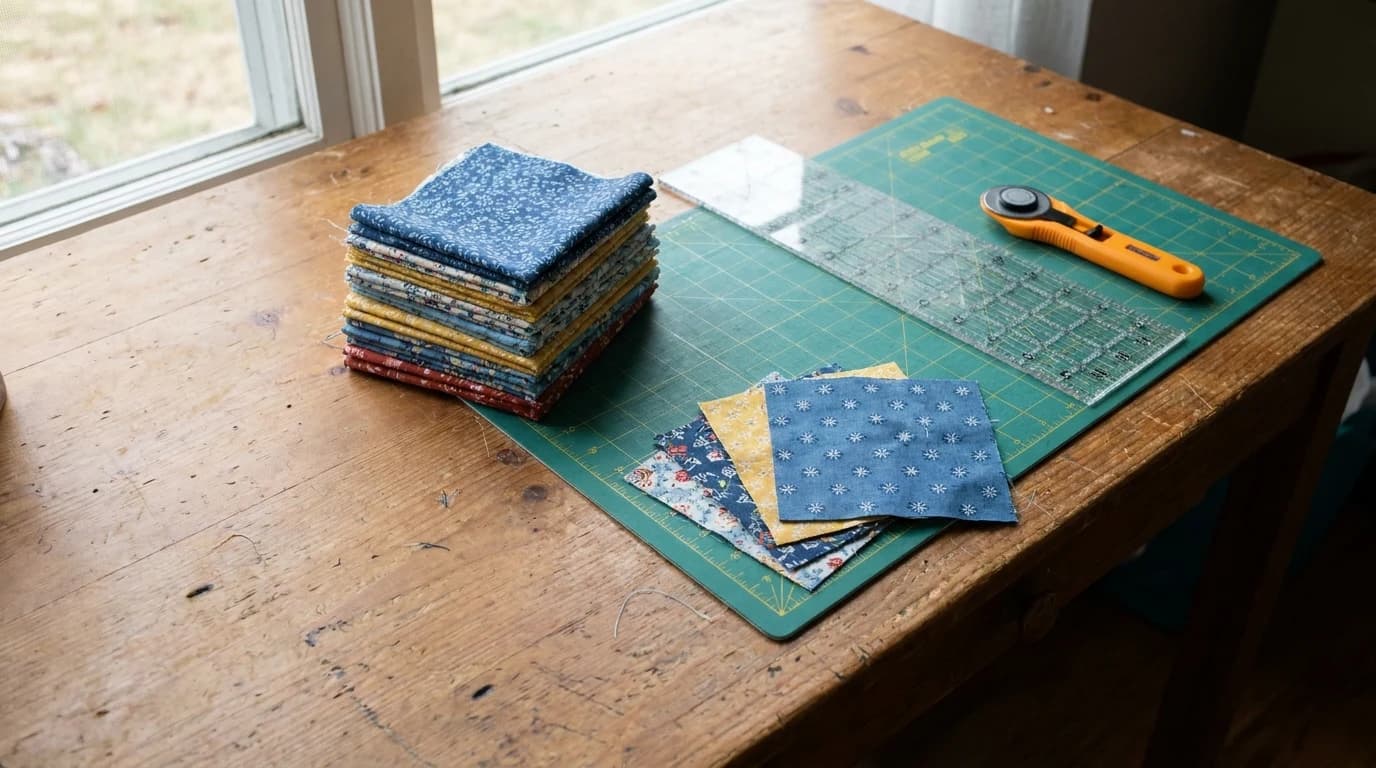
- Fold it to fit a small mat. The anezus 12-by-18-inch mat from our cutting mat shelf takes a fat quarter folded in half.
- Use a ruler longer than the piece. The Fiskars 6-by-24-inch ruler from our quilting rulers spans the 22-inch side in one pass.
- Cut with a rotary blade. The OLFA 45mm squeeze-handle cutter is the top pick in our rotary cutters category.
New to all this? The beginner quilting guide puts these cuts in order, and a wonky square still makes a quilt.
What we'd buy for this
One pick per category, chosen from the research pages linked in this piece. Borrow before you buy — nothing here is required to start.
 Cutting Mats
anezus 12inch$8.99 4.7 out of 5 stars · 21,438 ratings
The least expensive pick in this category, which makes it the low-risk way to find out whether you'll keep at it; the surface is self-healing, so rotary cuts close up instead of scarring into a groove that steers your next cut.
 Quilting Rulers
Fiskars$21.49 4.8 out of 5 stars · 3,291 ratings
Cutting from the bolt — a 6 by 24 inch ruler spans a folded width of quilting cotton, which the square rulers cannot, and Fiskars states two-tone gridlines for light and dark fabric plus 30, 45 and 60 degree angle indicators.
 Rotary Cutters
OLFA 45mm$19.79 4.7 out of 5 stars · 9,493 ratings
An everyday 45mm cutter that keeps its blade covered until you squeeze; the listing says the blade self-retracts when you let go, a dual-action lock holds it open or closed, and the curved, rubber-gripped handle is shaped to ease hand fatigue.
Researched from listings, specs and owner feedback — never hands-on testing. We may earn a commission; it never changes a pick.
Frequently asked
What size is a fat quarter of fabric?
About 18 by 22 inches. Some sellers list 18 by 21, since the long side is half the width of the fabric it was cut from. After selvage and trimming, about 17.5 by 20 inches is a sensible number to plan on.
Is a fat quarter the same as a quarter yard?
It holds the same amount of fabric, 396 square inches, in a different shape. A regular quarter yard is a long strip about 9 by 44 inches. A fat quarter is about 18 by 22, so it can yield larger pieces, including two 10-inch squares.
How many 5-inch squares can you cut from a fat quarter?
Twelve, cut 3 across and 4 down. That holds on both the 18 by 22 label size and a trimmed 17.5 by 20 inch piece. A 40-piece charm pack would take 4 fat quarters to cut yourself.
How many fat quarters make a yard?
Four. A yard is cut in half at the fold, and each half is divided into two 18-inch lengths.
How big is a fat eighth?
Half a fat quarter, in one of two shapes: about 11 by 18 inches or about 9 by 22 inches. Sources disagree on which is typical, and the shape changes what you can cut, so ask the seller if your pattern needs a 10-inch square.
Sources & further reading
Where our guidance rests on a fact, here is where that fact comes from.
- National Quilters Circle: What Is a Precut? — How a fat quarter is cut from a yard, quarter-yard shape, fat eighth size.
- C&T Publishing: Quilting with Precuts Is a Piece of Cake — Fat quarter, fat eighth, charm pack, layer cake and jelly roll sizes and typical counts.
- AccuQuilt: What Are Fabric Precuts and How to Use Them — The 18 by 21 heading, the approximately 20 inch figure, and the 9 by 40 strip.
- Linda's Electric Quilters: Fabric Pre-Cut Guide — Retailer sizes and piece counts for each precut format.
- The Polka Dot Chair: Guide to Precut Fabrics — Selvage affects usable fabric and varies by manufacturer.
- Moda Fabrics: To Wash or Not to Wash — Shrinkage runs mainly across the width, up to a couple of inches.
Prices and StitchScores reflect our most recent research and refresh on a cycle — confirm the live price before buying. We may earn a commission from affiliate retailers; it never changes what we recommend. See how we score gear.
Read next
How to Bind a Quilt: Strips, Corners and a Neat Finish
Learn to bind a rectangular quilt: calculate strips with diagonal join loss, sew mitered corners, join the tails, and choose a hand or machine finish.
Quilt Size Chart: Standard Sizes, Batting and Backing
Every standard quilt size in one chart: the mattress each covers, the drop it assumes, the batting to buy, backing yardage and binding strips.